A Submission for Nash — Brand Design Lead

In This One,
the Robot Is
On My Side

Walk with me through the Executives' Club of Chicago rebrand — the project I used to figure out what AI actually is when you stop using it to look things up and start using it to do your job.

Before this, my relationship with AI looked like: generating rough reference images I'd paint over anyway, drafting ad copy I'd immediately rewrite, figuring out why my foot hurt at 11pm (plantar fasciitis — very confident, offered no liability), and untangling why my kitchen light switch has four wires when every diagram on the internet shows three. Useful. But I was treating a comprehensive creative partner like a Swiss Army knife and only ever using the toothpick.

The Executives' Club of Chicago rebrand is where that changed. A 113-year-old institution with a name that worked like a velvet rope and a brief that asked me to take the rope down without losing the room. This is what using AI as a genuine collaborator looked like. I want to walk you through it, and then tell you why it matters for Nash.

Matt Pennetti Creative Director — Ashleigh Road Co. Chicago, IL

The Brief Arrives

The Executives' Club of Chicago had been around since 1911. One hundred and thirteen years of signature programming, corner-table lunches, and the sort of institutional credibility that accumulates the way limestone accumulates on a shoreline — slowly, without announcement, until suddenly it is just the shape of the thing.

The name was the whole problem. "Executives' Club" communicates exclusivity the way a velvet rope communicates exclusivity: accurately, and in a way that keeps most people on the wrong side of it. The goal was simple to say and difficult to do: take the brand from executive elite to business approachable — without losing the authority that made the membership worth having in the first place.

Opening materials
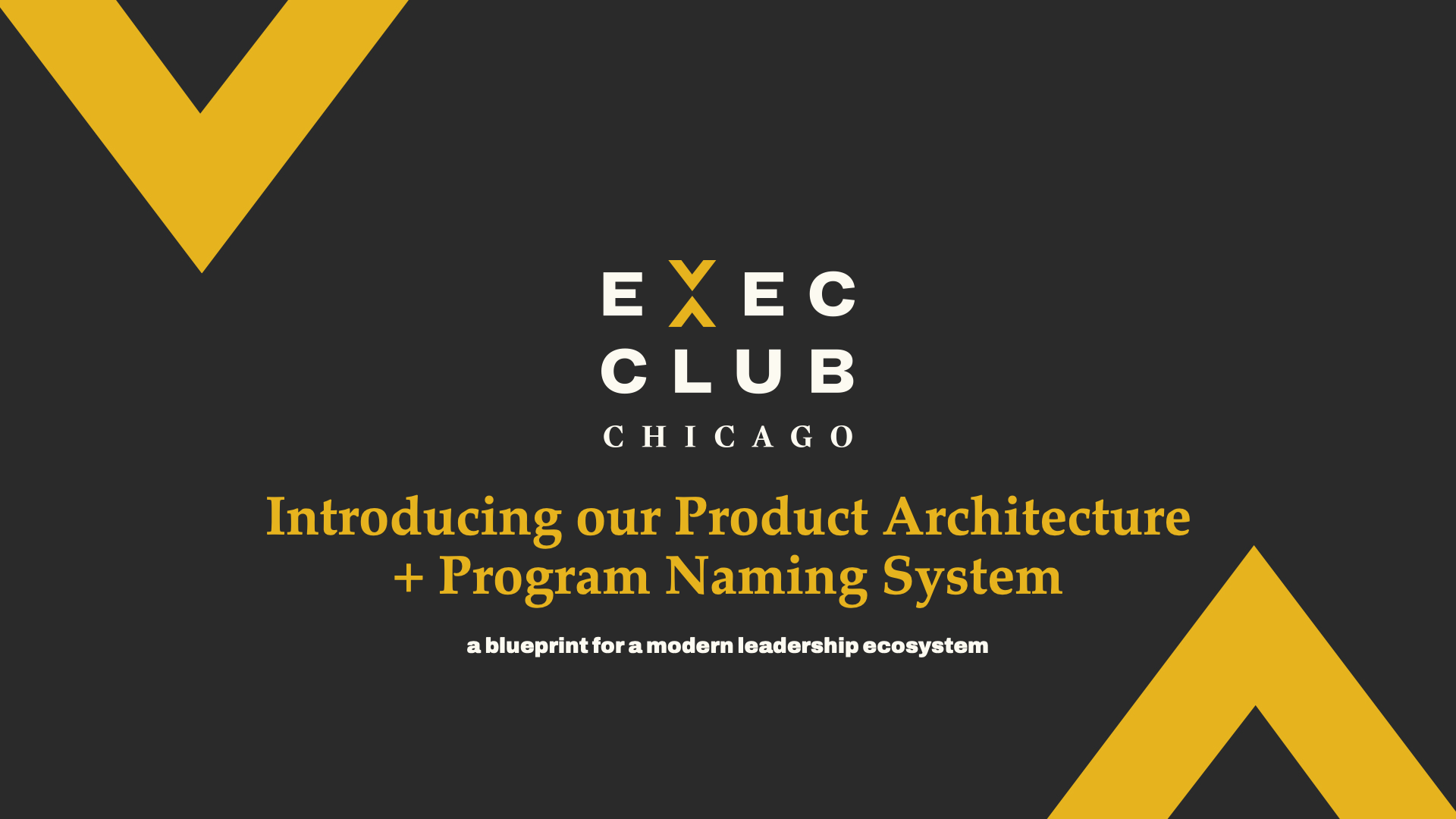
Client brief cover — Exec Club Product Architecture

My old intake process looked like this: print the brief, read it twice, fill half a notebook, and spend the better part of two weeks in the library of your own head before a single mark got made. Research, competitive analysis, territory mapping — all of it done by hand, in sequence, alone. A few weeks later, you had opinions. Some of them were even right.

The New Intake

The new process looks like this: the brief goes into ChatGPT in the first hour. Not to get answers — to pressure-test the questions. There is a real difference between asking an AI what to do and using it to find out whether the assumptions underneath your first instinct are load-bearing.

First Exchange — Positioning

"The Executives' Club of Chicago is pivoting from a CEO-only reputation to all career levels. The name still says 'Executives.' What does that word communicate to someone who's hearing about this organization for the very first time?"
It signals hierarchy before it signals value. The apostrophe placement tells you who the club belongs to. Someone early in their career reads that name and assumes the door is for someone else — not because the programming isn't for them, but because the name has already told them it isn't.

A three-minute conversation that confirmed two weeks of suspicion. Twenty years of craft tells you what to ask for. AI tells you faster whether the answer you're assuming is the right one.

Original identity

The name that opened the conversation.


The Collaboration

What followed was not a handoff. It was a working relationship — the kind where one party brings institutional memory and creative judgment, and the other brings patience, speed, and no investment in being right. That last one is genuinely underrated in a collaborator.

Exchange 02 — The Audit

"Audit the competitive landscape for professional leadership organizations nationally. Top 25. Then drill to Chicago's top five — ranked by brand presence, longevity, and membership model. Pull logos, brand language, founding year."
National landscape mapped and narrowed: 25 organizations ranked, top 5 Chicago institutions identified. Logos, brand positioning, founding dates, and membership structures for each. Competitive white space: approachable authority. No one is owning it.

Work that would have taken two or three days took about four minutes. Nobody was owning approachable authority. That was the opening.

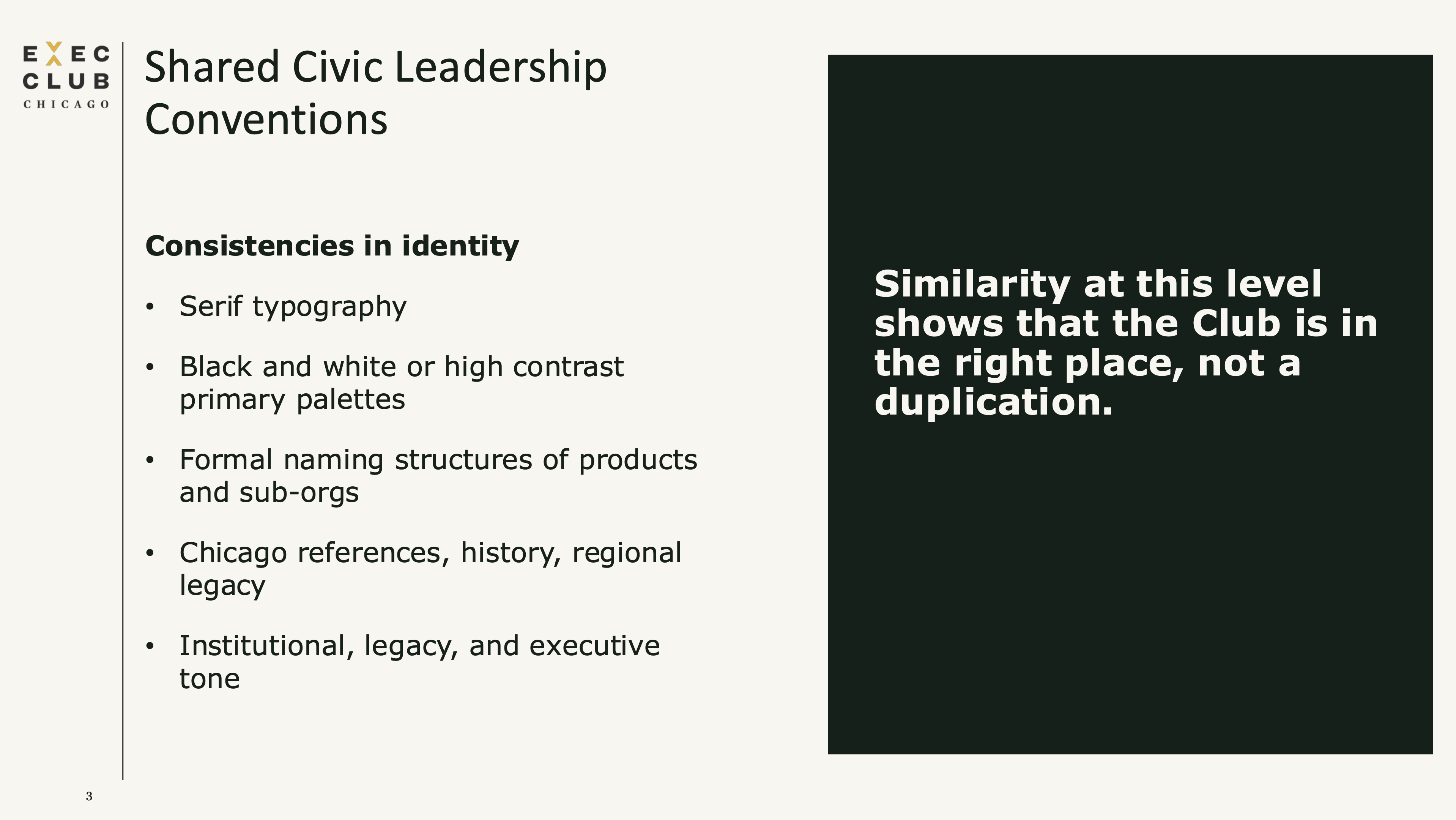
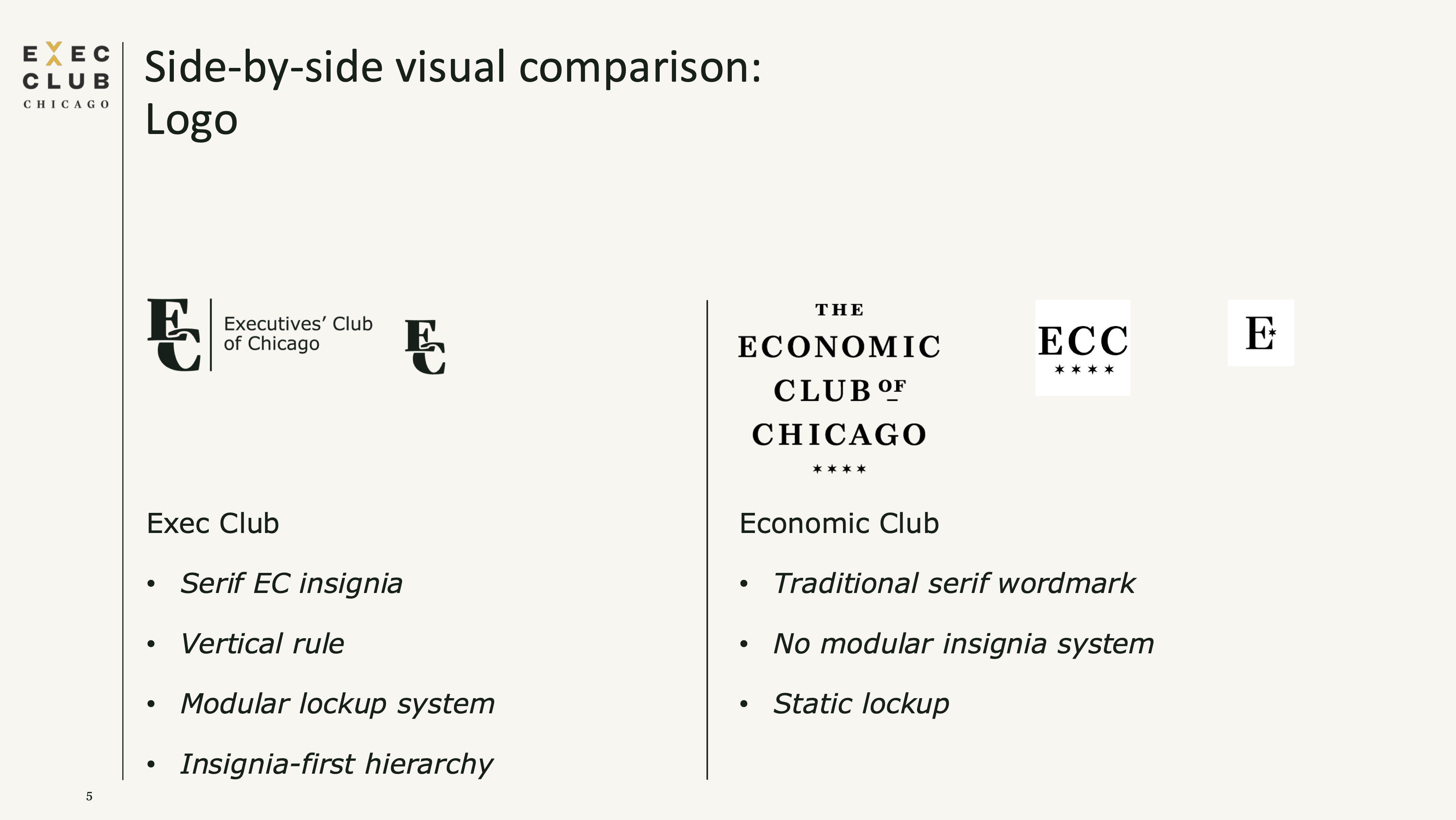
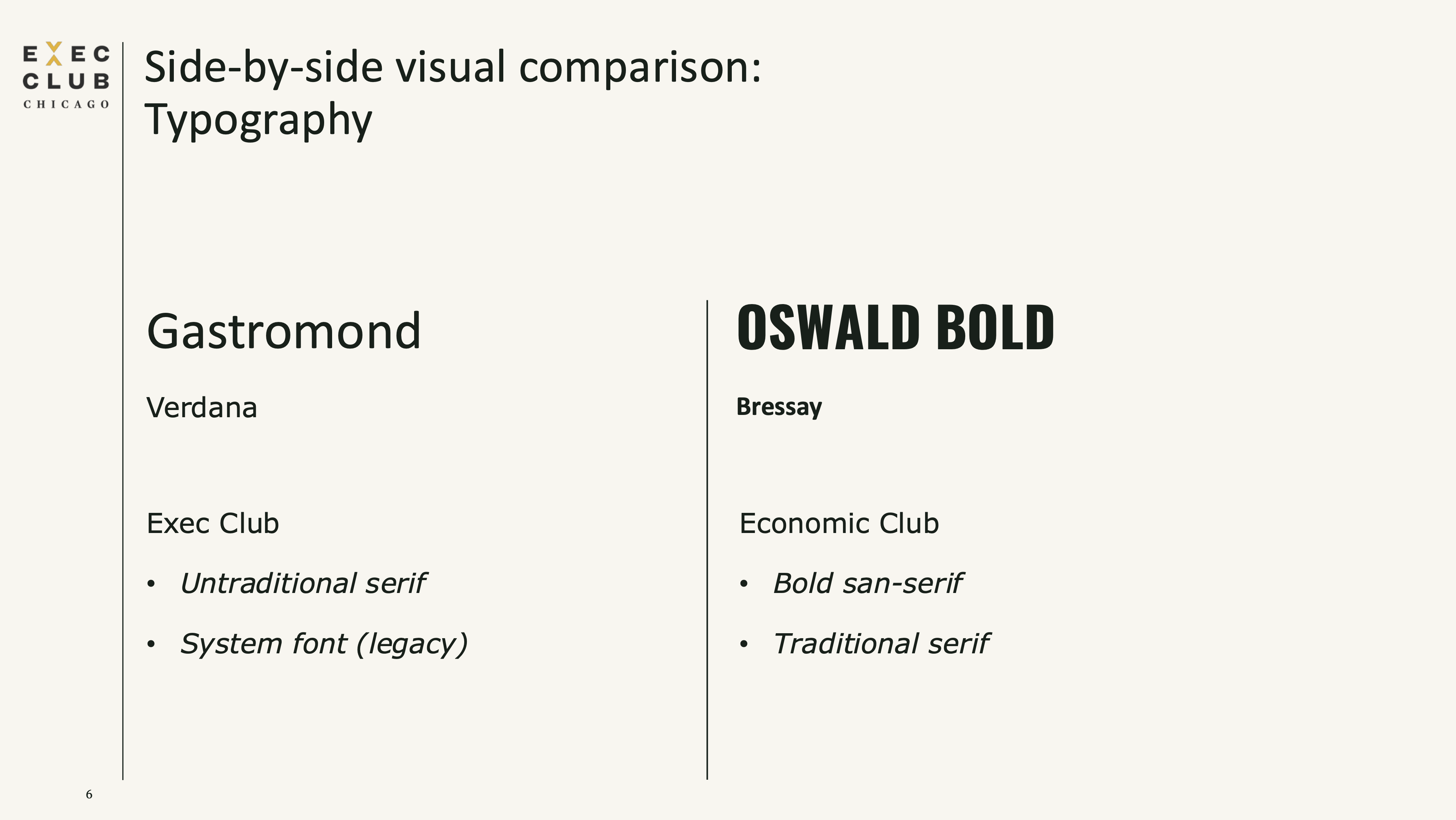
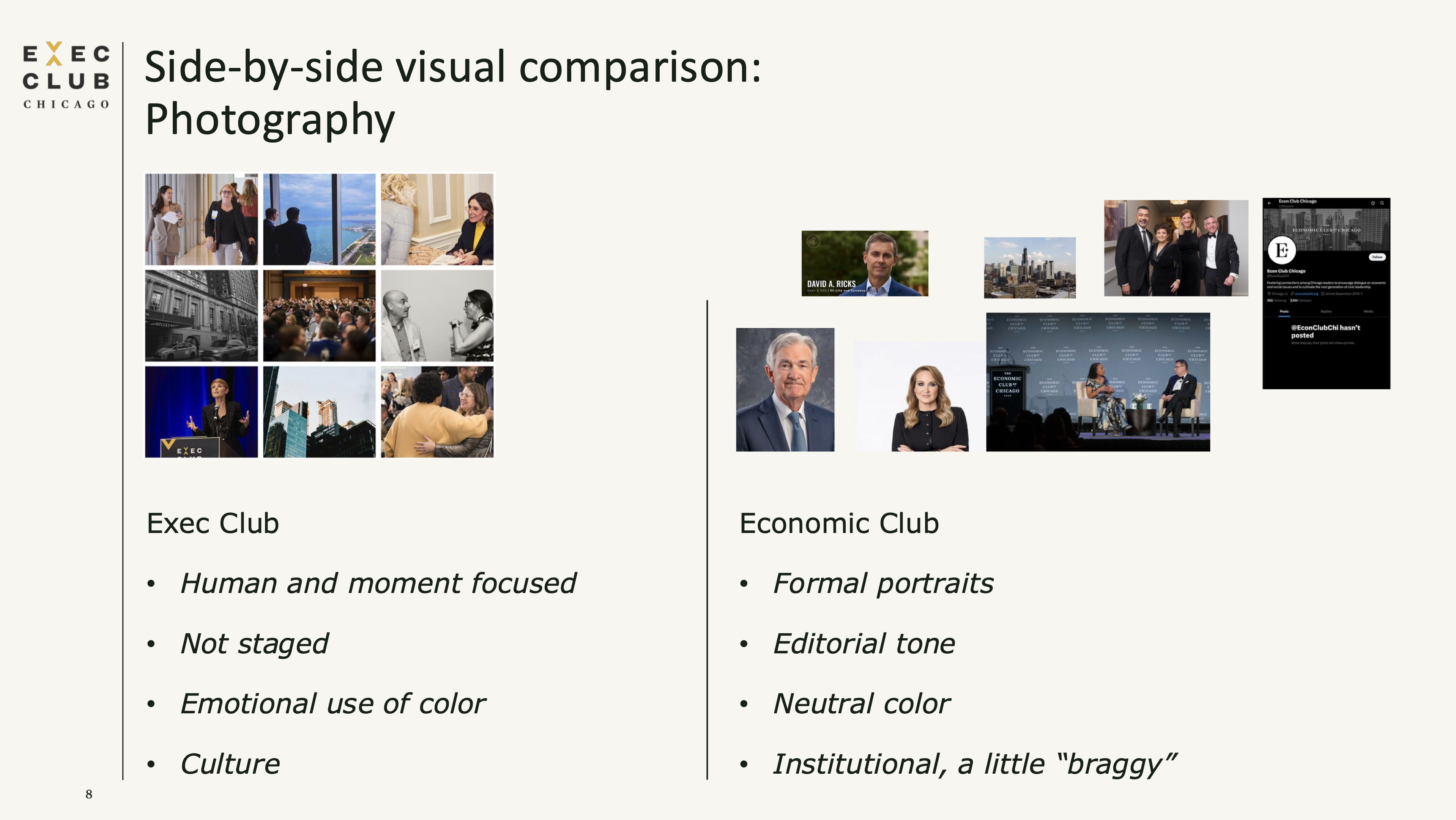
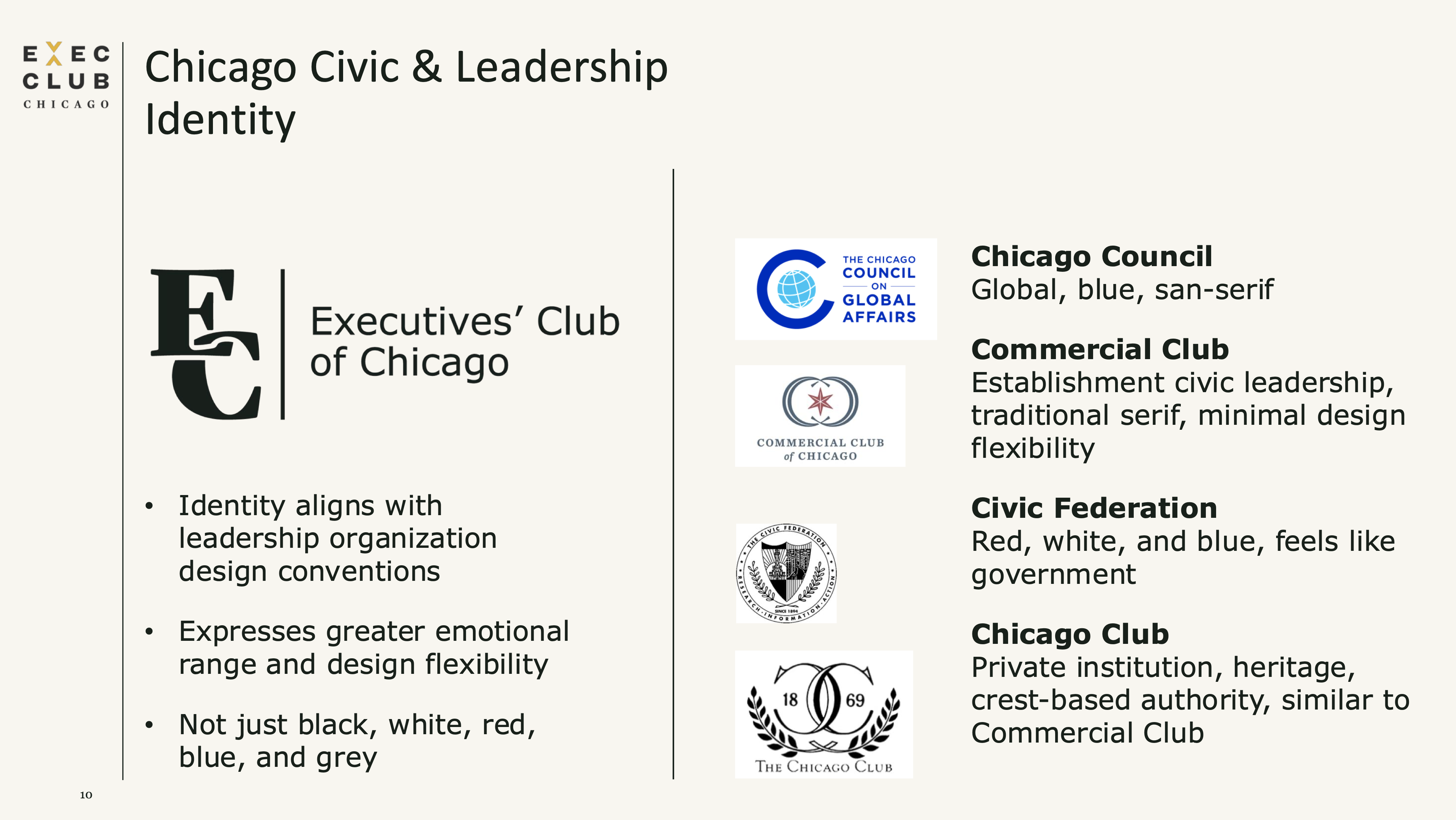
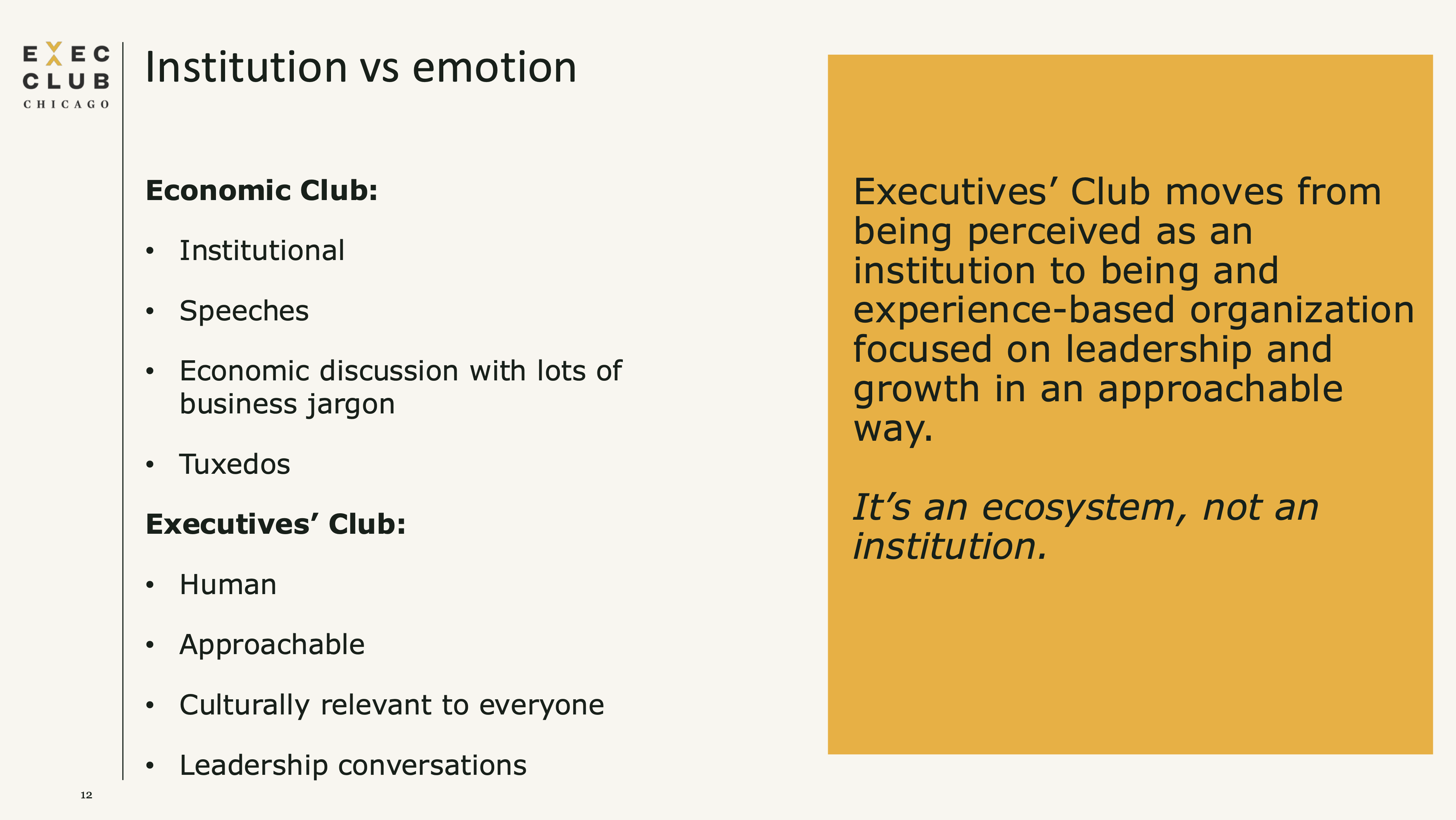
Competitive audit

Competitive landscape — scroll to see the full audit below.

Exchange 03 — The Name Question

"If we keep the name and change the visual language, are we painting over the problem or actually solving it?"
The name is a perception problem, not a structural one. Changing the visual language signals the room has changed — who's in it, who's welcome, what happens there. Whether that signal holds depends on the programming backing it up.

Keep the authority. Change what the door looks like. That became the constraint the entire system was built around.

Competitive analysis detail

Where everyone else was positioned.

Exchange 04 — Color Strategy

"I'm building a color system around emotional register rather than product application — 8 colors tied to feelings, not use cases. Push back on this if I'm wrong."
Conventional pushback: emotion-based systems fail at scale because they're too subjective. Counter: tying to emotion rather than product gives more scalability, not less. You're not locked to a category the brand might outgrow.

The counter-argument became a selling point in the client presentation. Eight colors tied to emotion, allowing for infinite scalability without limitations to brand expansion.

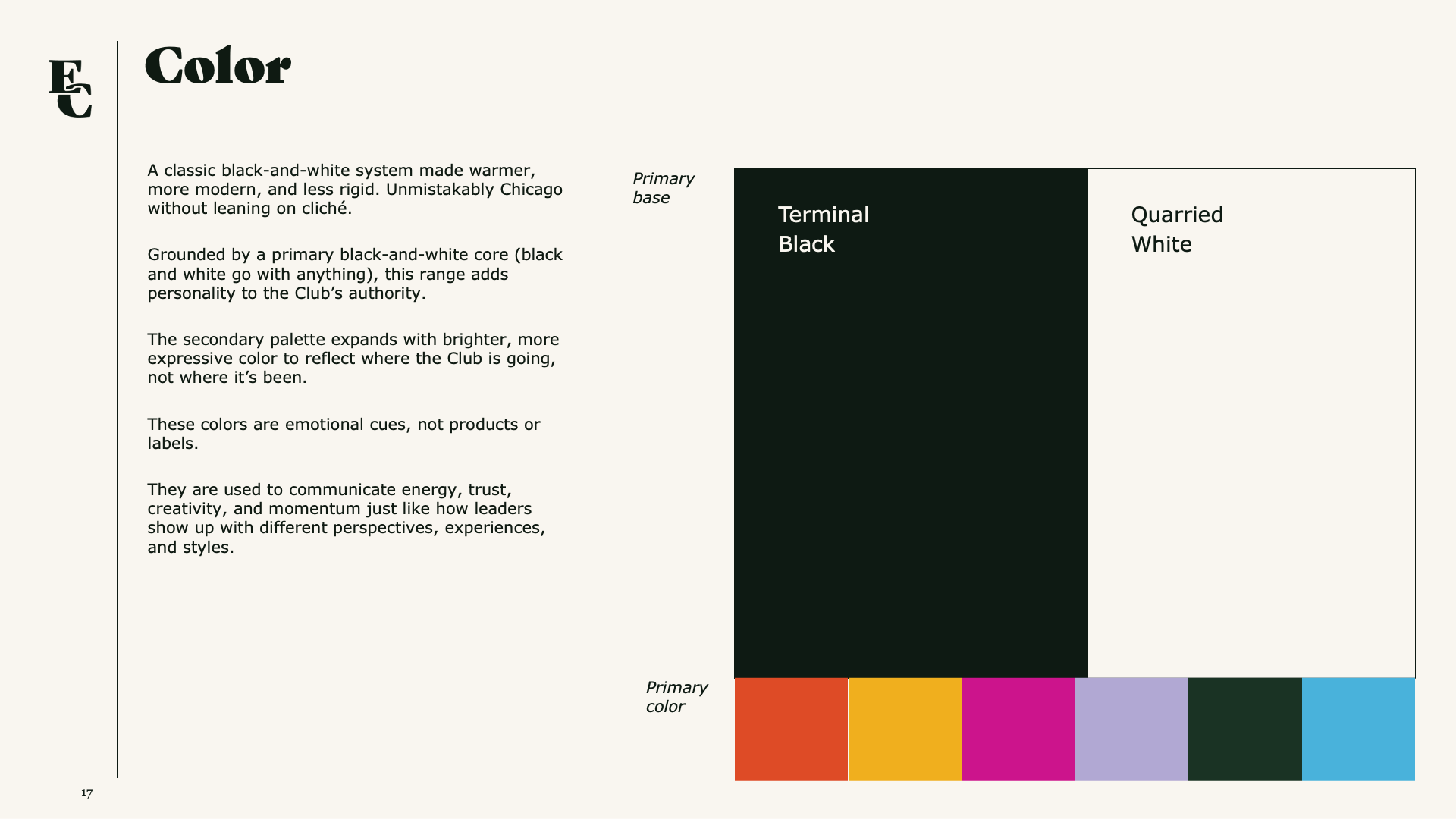
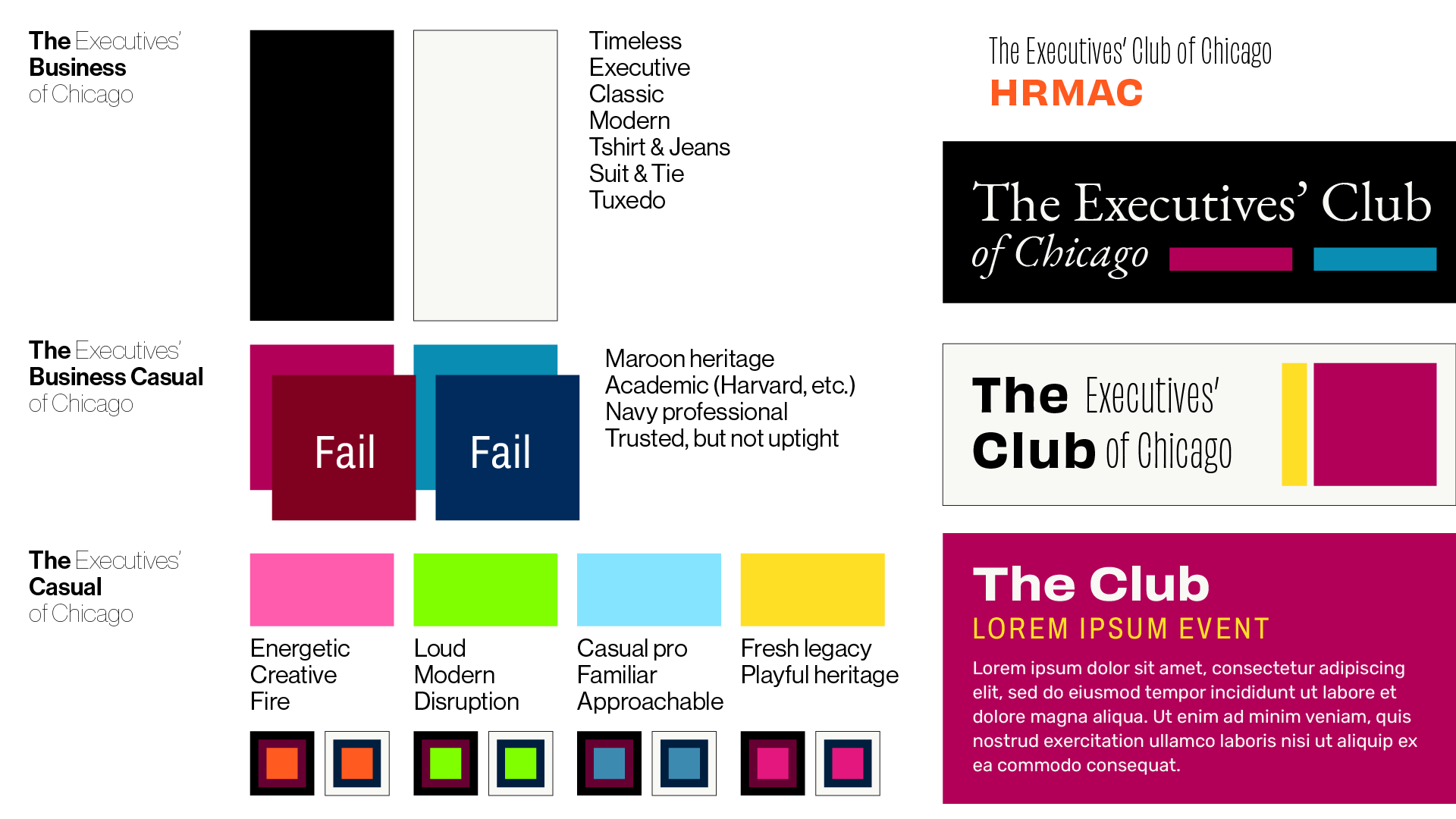
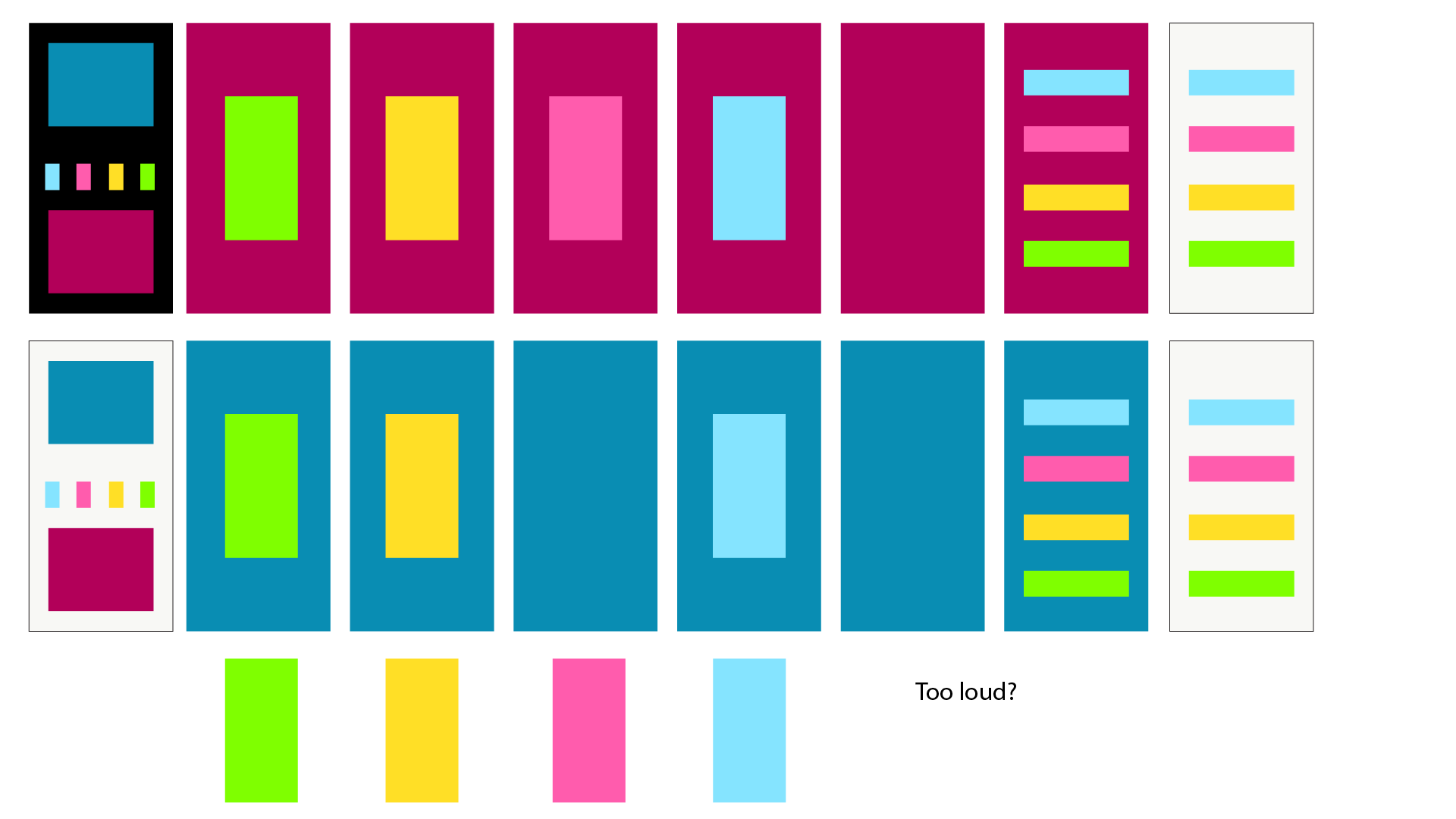
Color system

The system that came out of it.

Exchange 05 — Positioning Language

"Write three positioning directions for an organization trying to feel like a room everyone belongs in, not just the people who own the building."
Three directions: (1) Authority redefined — leadership is a practice, not a title. (2) The room that moves Chicago forward. (3) Where your next chapter starts, regardless of which one you're on.

None of the three shipped. What shipped came from reading all three and understanding what was missing: they described membership. The brand needed to describe possibility. AI pointed to the gap without knowing it was pointing to it.

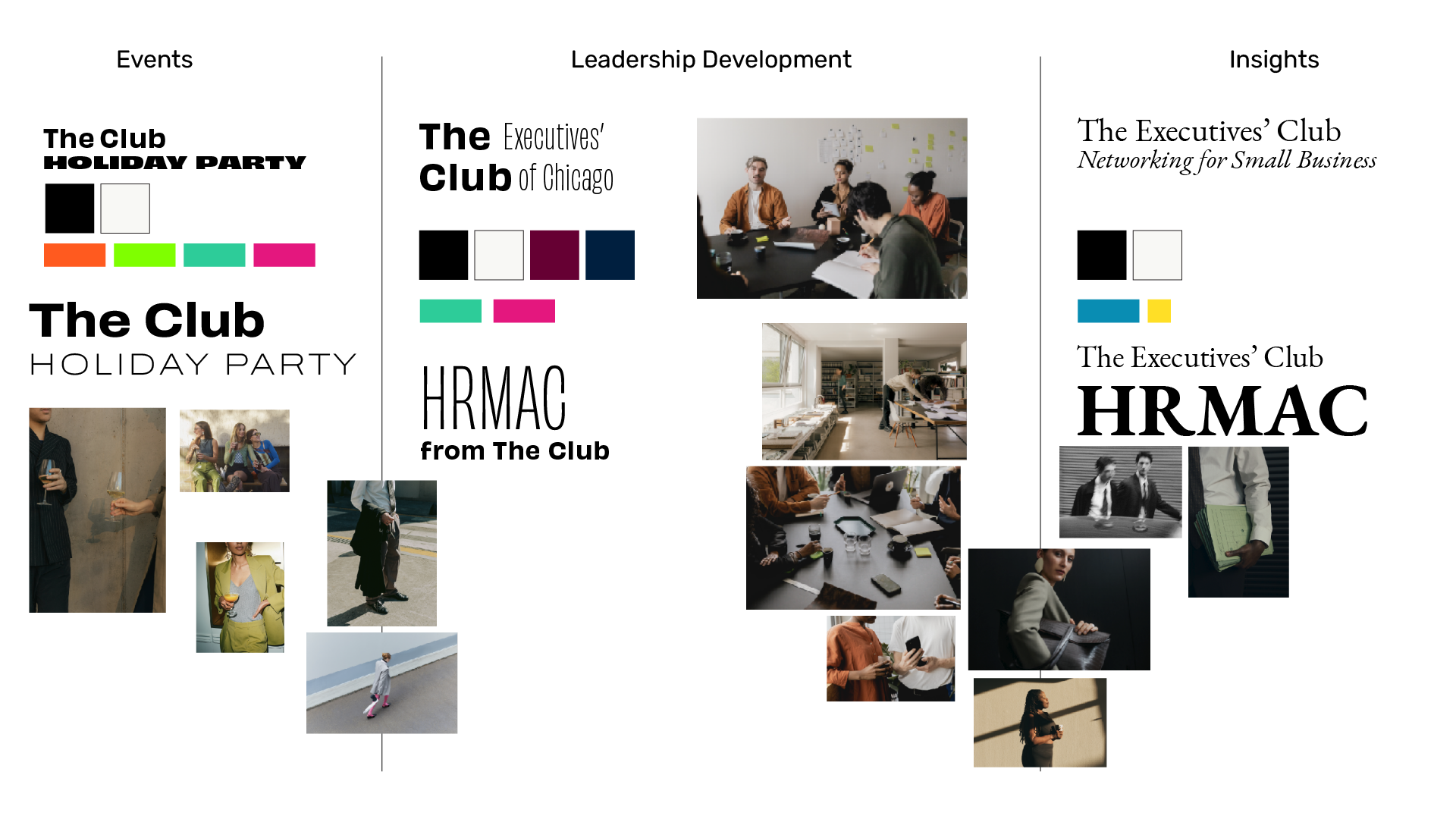
Brand guide cover

Where the conversation ended up.

What AI could not do was tell me what any of this should make someone feel the first time they see it. That decision is craft. It is made once, quickly, and then defended — or it is made wrong.


What Came Back

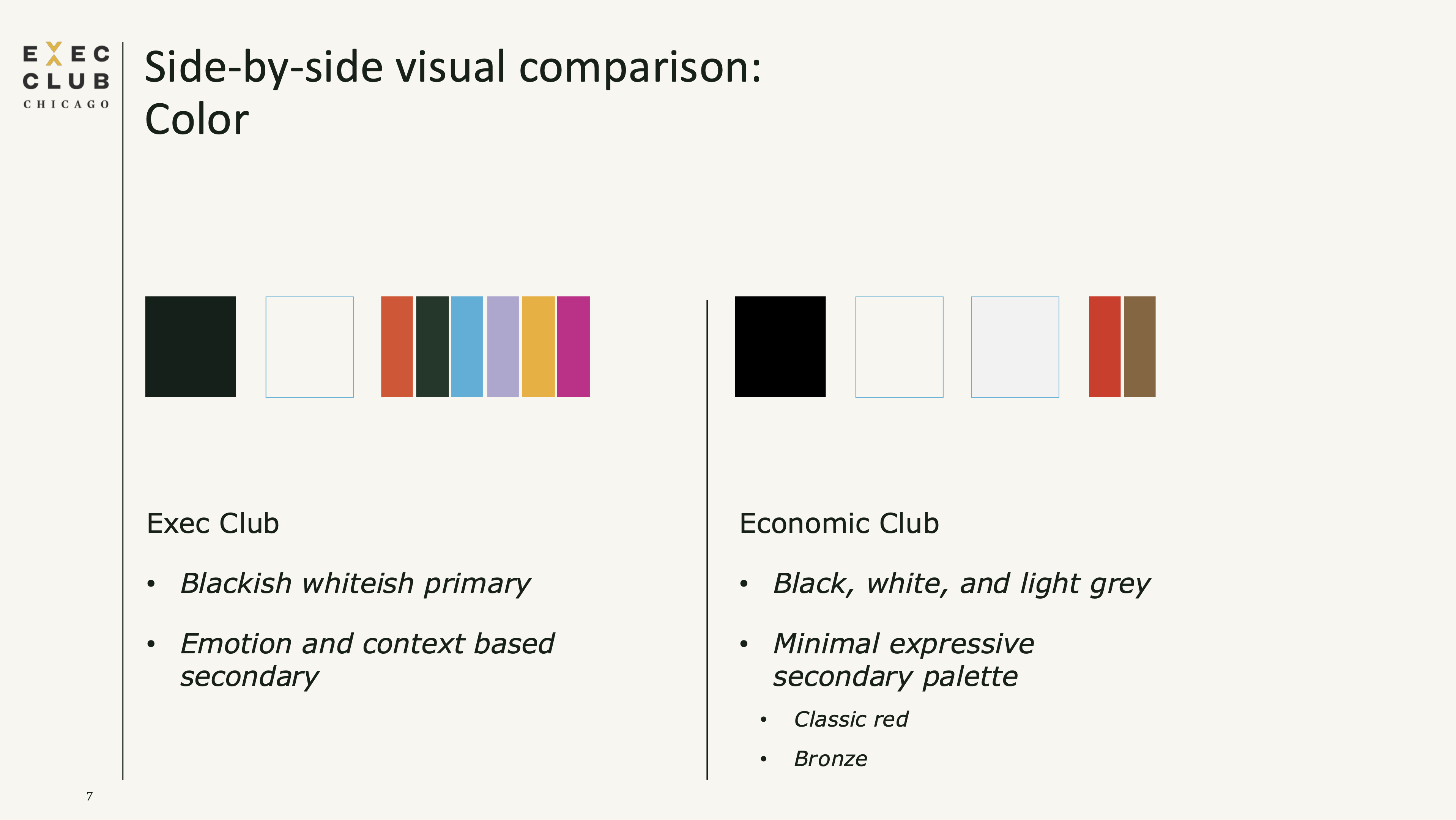
Eight colors. Not a palette chosen for product — a palette chosen for emotion. Each color tied to a specific register, so any combination works, because the system is built around feeling rather than application.

Harbor Blue
#4AB2BD
Guild Gold
#F0AF1E
Signal Magenta
#CC148C
Burnt Orange
#DE4B26
Evergreen
#1A3325
Lilac
#B1A8D3
Quarried White
#F9F6F0
Terminal Black
#0E1A13

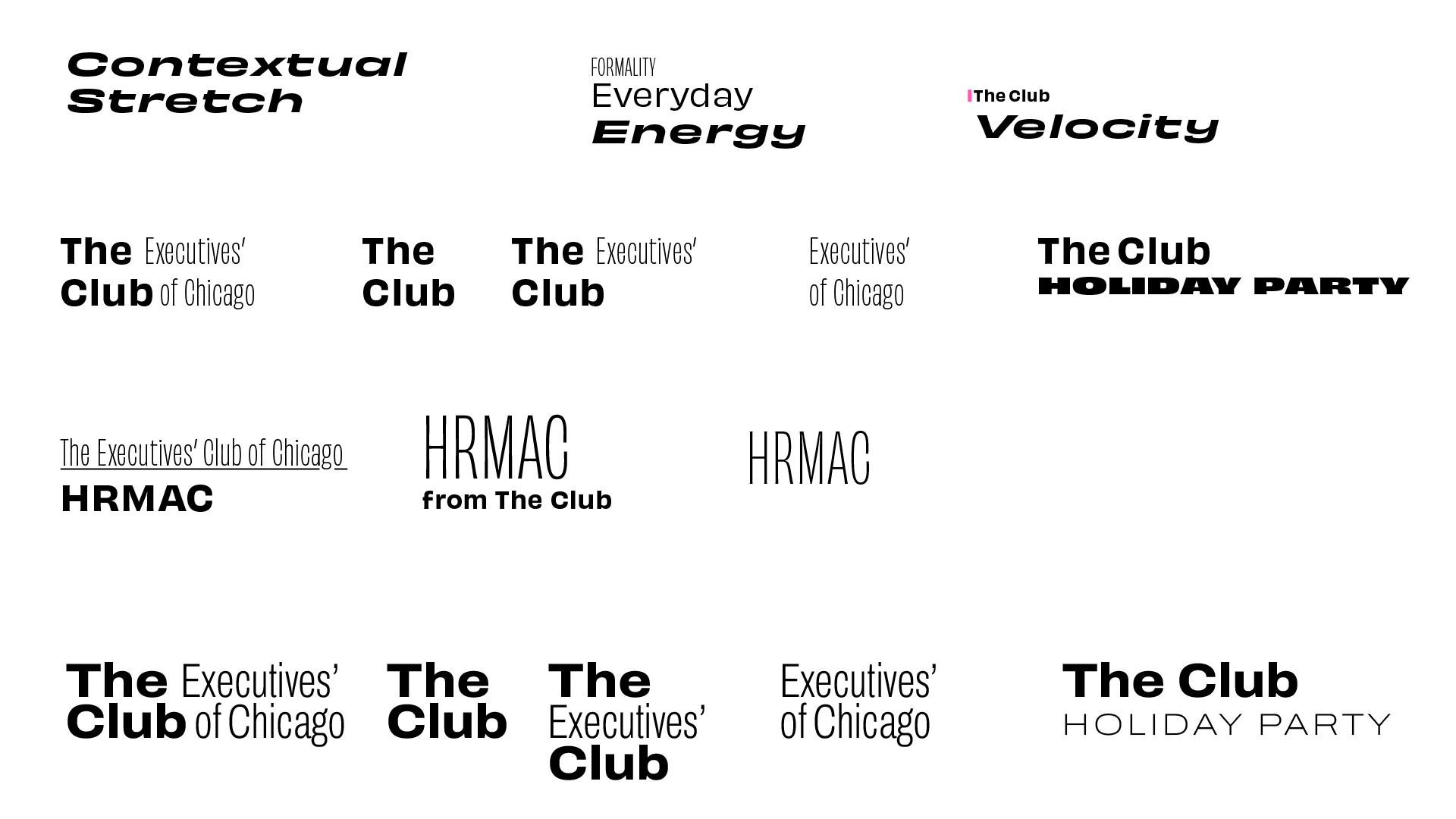
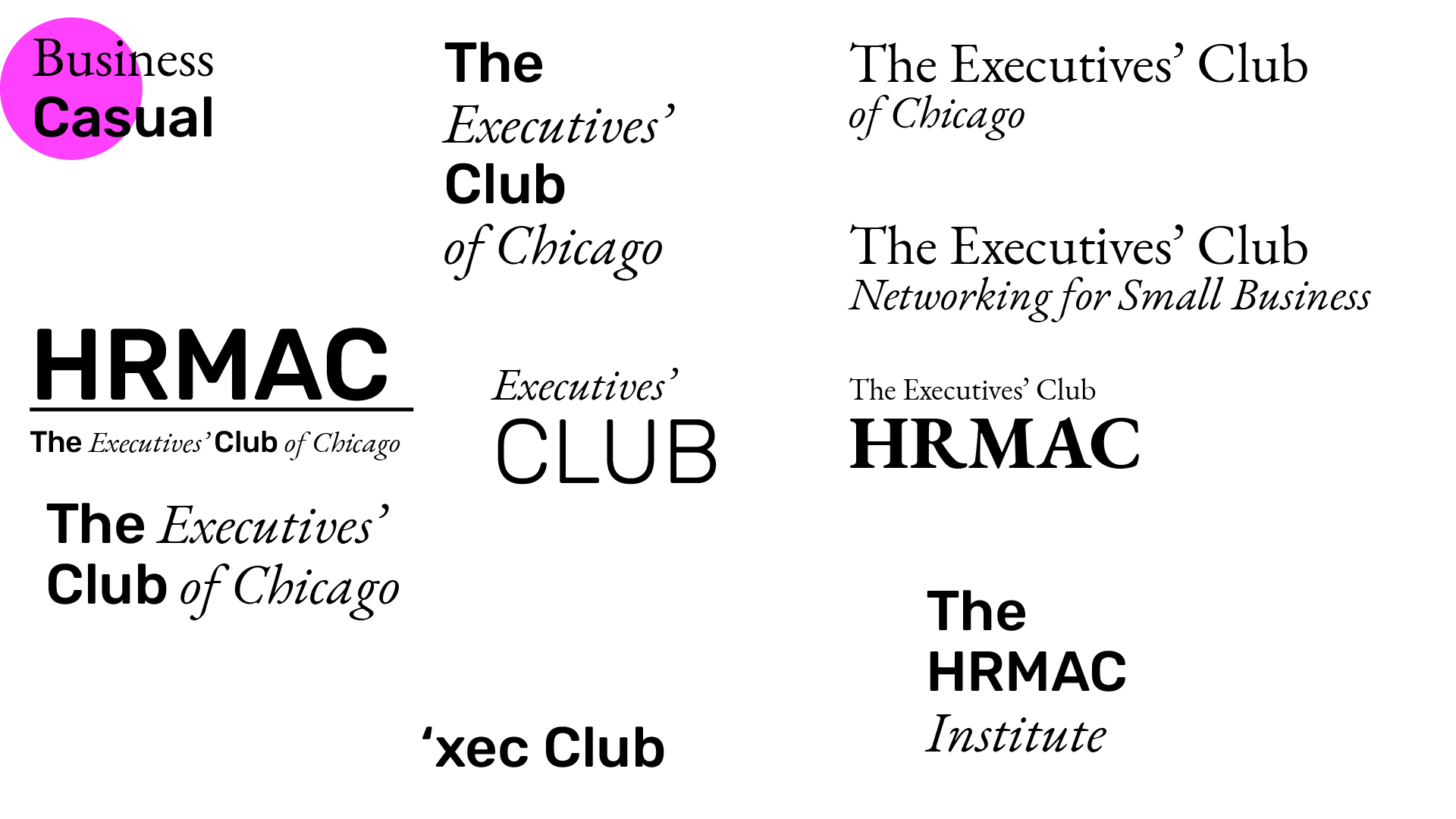
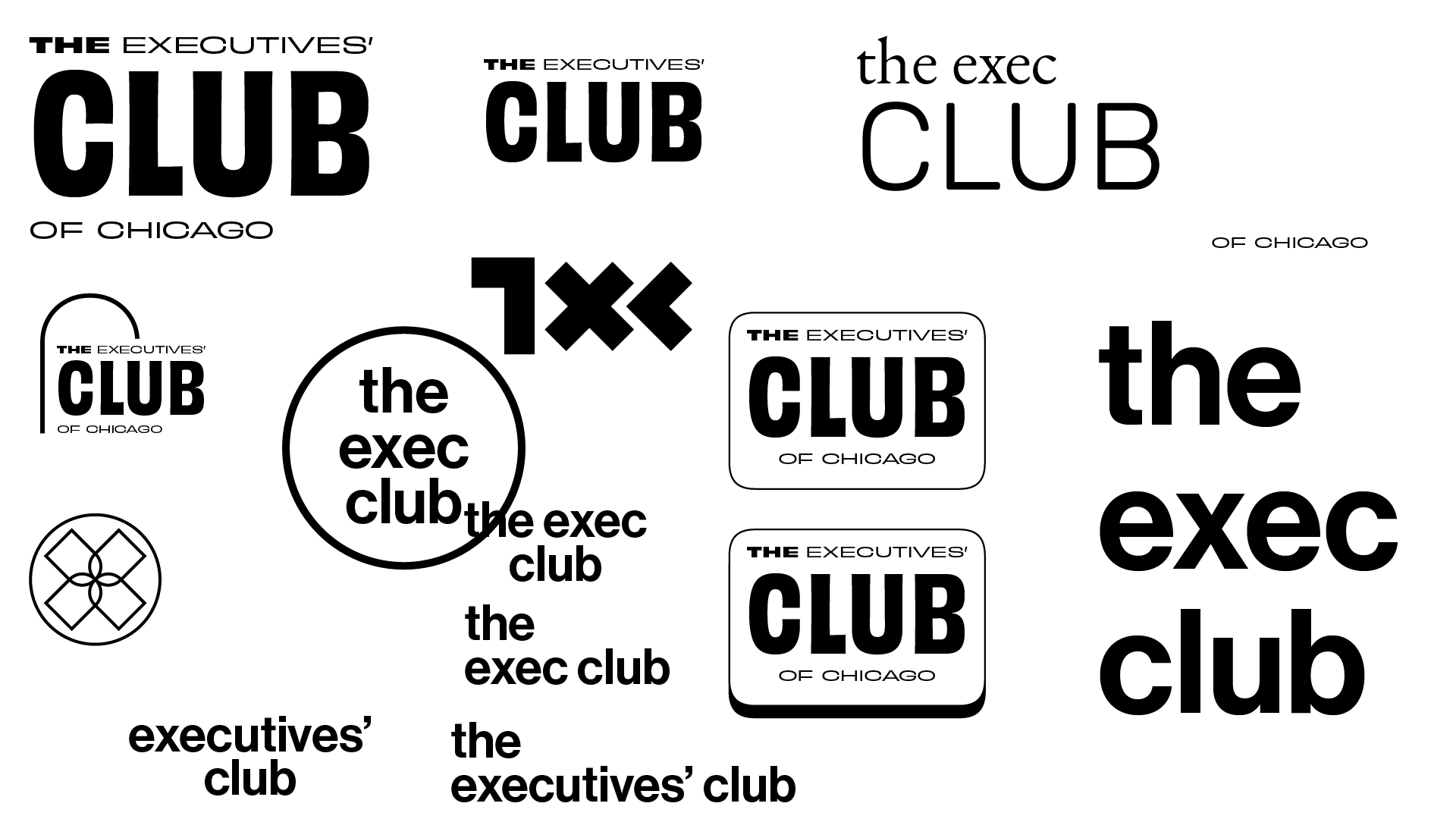
Logo Explorations — Round 1

v1-01 v1-02 v1-03 v1-04 v1-05 v1-06 v1-07 v1-08 v1-09

Before / After

Same organization. Different door.

Before
After
BeforeAfter

Brand Playbook

Brand guide

1 / 28


What It Taught Me

The goal was to move the brand from executive elite to business approachable — without losing the thing that made it worth approaching. Those two directives pull in opposite directions and will keep pulling until someone makes a decision about what the brand is supposed to make people feel the first time they see it. AI did not make that decision. That decision is mine.

When you work alone — which is most of what freelance actually looks like — there is no one in the room to push back on your first instinct. The thing you think in the first hour of a project has a way of becoming the thing you deliver, because no one showed up to tell you it was wrong. Sometimes it is not wrong. The problem is you cannot tell the difference.

AI showed up. Not to make the decisions — it cannot do that, and when it tries, the seams are visible from across the room. But it developed the habit of asking me why. Why this color and not that one? Why this word? Why does this feel right? That is the question a good creative director asks a junior designer. For a long time, I did not have a creative director in the room. I had a chat window that would ask at two in the morning if I needed it to.


Why Nash

Nash is building the brand for infrastructure that moves commerce — quietly, invisibly, without ceremony, and for clients who notice immediately when it stops working. I know this category. I spent years inside it with Zebra Technologies at NRF, HIMSS, and MODEX: building the visual language of systems that no one thinks about until they do, and then everyone does at once.

The Executives' Club brief and the Nash brief are the same brief. Legacy perception in a saturated market. The need to feel authoritative and approachable at the same time, without those two things canceling each other out. I have done this before. The medium changes. The problem does not.

"When You Do Things Right, People Won't Be Sure You've Done Anything at All"

— Futurama, "Godfellas," 2002. That is the Nash brief.

What I bring is not a logo. It is a system — a way of thinking about visual language that scales into any medium, survives the next product category, and holds together when someone who is not me has to use it. The next designer can use it without calling me first. That is what a brand system is supposed to do.

I am a player-coach. I do the work and I build the team around the work. The AI-native workflow is not a feature of how I operate — it is the operating system. Twenty years of knowing where the holes go. A really good drill. A genuine preference for building something that lasts over something that wins an award.

I built that system alone.
I would rather build it with people.


Before the Robot

Before I had a creative collaborator that never slept and had no opinions about the conference room temperature, I had a team. Sometimes I was on it. Sometimes I was running it. Sometimes I was the freelancer they called after the first person they hired turned out to have thoughts that were expensive. The work survived all three configurations, across twenty years, with humans, using a notebook and strong opinions and the quiet terror of a deadline.

It held together, more or less. The mistakes are mine. The good calls are also mine, which is one advantage of a system without a lot of other moving parts.

View Identity Samples ↗

"For historical comparison: twenty years of work from the period when I was on a team, the lead, or brought in as an extra hand. Which tells you something, though I'm not entirely sure what."

TL;DR

Skip to the good part — my portfolio and résumé are one click away.

Portfolio ↗ Résumé ↗